
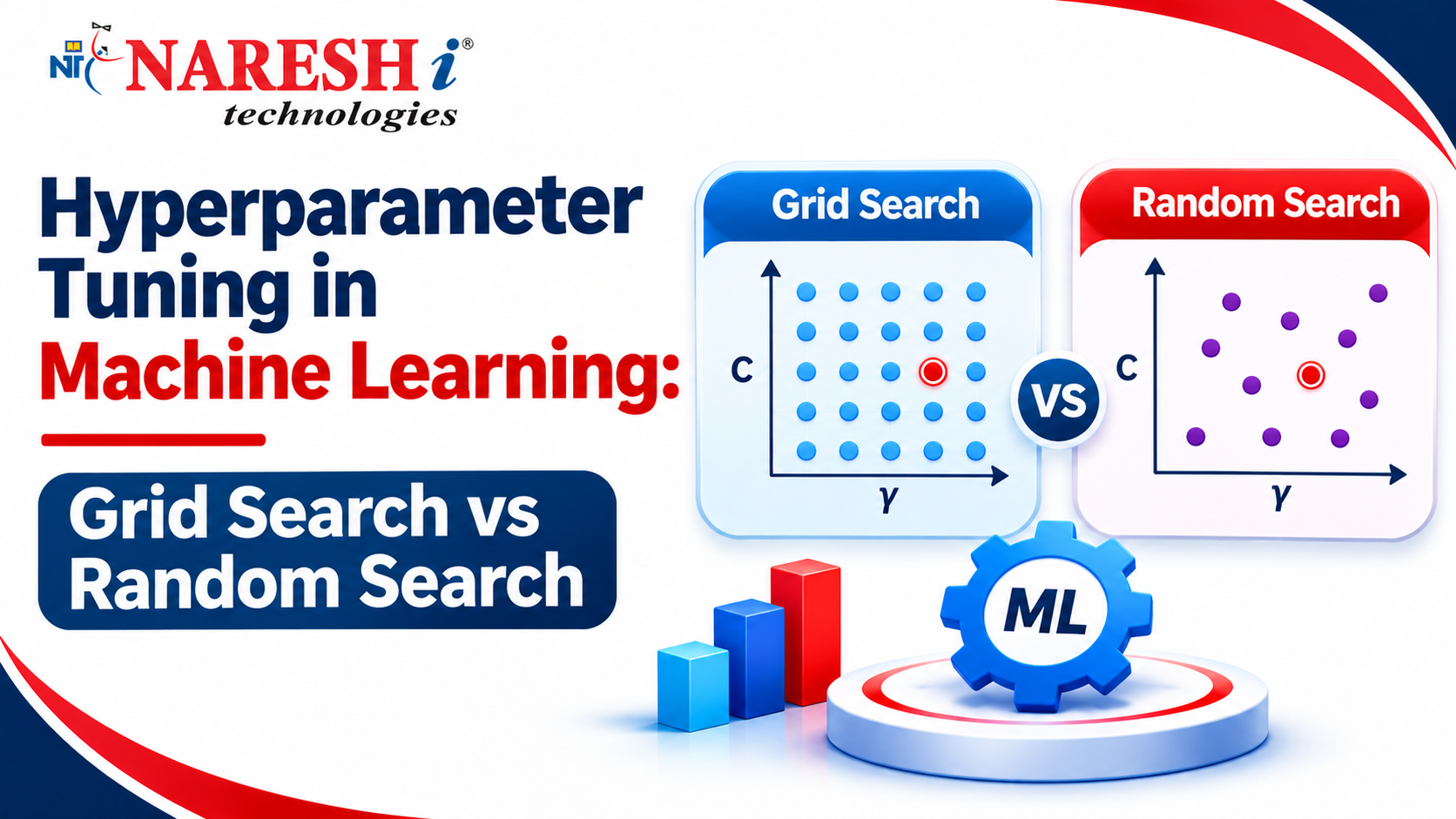
Hyperparameter Tuning in Machine Learning helps developers improve how predictive models learn and perform on new data. After choosing an algorithm, the next challenge is deciding which settings will produce useful results.
Imagine building a customer churn prediction model. A decision tree might perform differently depending on its maximum depth, minimum samples per leaf and other settings. Choosing these values randomly without evaluation can lead to unreliable results.
Quick Answer: Hyperparameter tuning is the process of selecting suitable model configuration values through systematic experiments. Grid Search evaluates every combination in a defined parameter grid, while Random Search evaluates a selected number of sampled combinations.
What Is Hyperparameter Tuning in Machine Learning?
A hyperparameter is a configuration setting selected before or during the model training process rather than learned directly as a fitted model parameter.
For example, the maximum depth of a decision tree controls how complex the tree is allowed to become. Similarly, the number of neighbours in K-Nearest Neighbors influences how predictions are calculated.
Hyperparameter tuning compares alternative settings using a validation strategy to identify configurations that perform well on unseen observations.
Why Is Hyperparameter Tuning Important?
A model’s performance depends not only on the algorithm and training data but also on its configuration.
An excessively complex decision tree may overfit, while a highly restricted tree may underfit.
Hyperparameter tuning can help developers:
- Improve validation performance.
- Control model complexity.
- Compare different configurations consistently.
- Balance predictive quality and computational cost.
- Select settings using reproducible experiments.
However, tuning cannot guarantee better performance on every new dataset. Data quality, feature selection and appropriate evaluation remain essential.
Parameters vs Hyperparameters: What’s the Difference?
Model parameters are learned from training data. Hyperparameters control aspects of the learning process or model structure.
| Factor | Model Parameters | Hyperparameters |
|---|---|---|
| How obtained | Learned from training data | Chosen through configuration or tuning |
| Example | Regression coefficients | Regularization strength |
| Purpose | Represent learned relationships | Control model behaviour |
Understanding this distinction helps beginners identify which settings can be tuned and which values are calculated during training.
What Is Grid Search in Machine Learning?
Grid Search evaluates every combination of values in a predefined hyperparameter grid.
Suppose a decision tree has two possible maximum depths and three possible minimum leaf sizes. Grid Search evaluates all six combinations.
This approach is straightforward and reproducible. However, the number of experiments grows quickly as more hyperparameters and values are added.
Python Example: GridSearchCV
from sklearn.datasets import load_iris
from sklearn.model_selection import train_test_split
from sklearn.model_selection import GridSearchCV
from sklearn.tree import DecisionTreeClassifier

X, y = load_iris(return_X_y=True)

X_train, X_test, y_train, y_test = train_test_split(
    X, y,
    test_size=0.2,
    random_state=42,
    stratify=y
)

model = DecisionTreeClassifier(
    random_state=42
)

param_grid = {
    "max_depth": [2, 3, 4, 5],
    "min_samples_leaf": [1, 2, 4]
}

grid_search = GridSearchCV(
    estimator=model,
    param_grid=param_grid,
    cv=5,
    scoring="accuracy"
)

grid_search.fit(X_train, y_train)

print("Best Parameters:")
print(grid_search.best_params_)

print("Test Accuracy:")
print(grid_search.score(X_test, y_test))
This example compares 12 parameter combinations using five-fold cross-validation, resulting in 60 cross-validation fits. With the default refitting behaviour, the best configuration is then fitted again using the full training subset.
The test set remains separate until final evaluation.
What Is Random Search in Machine Learning?
Random Search explores a specified number of hyperparameter configurations sampled from defined lists or probability distributions.
Instead of evaluating every possible combination, it uses a limited search budget.
For example, if a search space contains hundreds of configurations, Random Search can evaluate only a selected number of candidates.
This can be particularly useful when models are computationally expensive or when the hyperparameter search space is large.
Python Example: RandomizedSearchCV
from sklearn.model_selection import RandomizedSearchCV

param_distributions = {
    "max_depth": [2, 3, 4, 5, 6, 7],
    "min_samples_leaf": [1, 2, 3, 4, 5]
}

random_search = RandomizedSearchCV(
    estimator=DecisionTreeClassifier(
        random_state=42
    ),
    param_distributions=param_distributions,
    n_iter=10,
    cv=5,
    scoring="accuracy",
    random_state=42
)

random_search.fit(X_train, y_train)

print("Best Parameters:")
print(random_search.best_params_)

print("Test Accuracy:")
print(random_search.score(X_test, y_test))
Here, Random Search samples 10 different combinations from the 30 possible configurations. Five-fold cross-validation gives 50 validation fits, followed by refitting the selected model.
The selected settings may differ from Grid Search because the candidate configurations and search strategies differ.
Grid Search vs Random Search: Key Differences
| Feature | Grid Search | Random Search |
|---|---|---|
| Search method | Every specified combination | Sampled combinations |
| Computational cost | Can become expensive | Controlled by search budget |
| Search space | Explicit parameter grid | Lists or distributions |
| Best suited for | Small, focused search spaces | Larger search spaces |
| Scikit-learn class | GridSearchCV | RandomizedSearchCV |
Grid Search is often convenient when only a few parameter combinations need to be tested. Random Search is a practical alternative when computational resources or experimentation time are limited.
Explore Course →
How Does Cross-Validation Help Hyperparameter Tuning?
Cross-validation evaluates each configuration across multiple training-validation splits instead of relying on one validation subset.
For example, a five-fold search calculates five validation scores for every candidate configuration.
These scores are combined to compare the candidates and select a promising configuration.
However, the cross-validation score used to select hyperparameters should not automatically be treated as an unbiased final performance estimate.
An independent test set or an appropriate nested cross-validation strategy can provide a more reliable final evaluation.
Which Is Better: Grid Search or Random Search?
Neither method is universally better.
Grid Search is useful when you already know a relatively small set of promising hyperparameter values.
Random Search may be more efficient when several hyperparameters need to be explored over a broad range.
A practical strategy is to begin with Random Search to identify promising regions, then conduct a smaller focused search if additional refinement is useful.
The final decision should depend on model performance, available computing resources and the size of the search space.
Common Hyperparameter Tuning Mistakes
One common mistake is selecting hyperparameters using the test dataset. This compromises the independence of the final evaluation.
Another mistake is applying data preprocessing before cross-validation. Scaling or imputation statistics calculated using validation records may cause data leakage.
Using Scikit-learn Pipelines helps ensure that preprocessing is fitted within each training fold.
Beginners should also avoid using only accuracy for imbalanced classification problems. Metrics such as precision, recall, F1-score and balanced accuracy may be more informative.
Beginner Project: Tune a Customer Churn Prediction Model
Customer churn prediction is a practical project for comparing tuning strategies.
- Collect an appropriate customer churn dataset.
- Separate training and testing records.
- Prepare features using a preprocessing pipeline.
- Train a baseline classification model.
- Apply Grid Search using selected hyperparameter values.
- Apply Random Search with a fixed search budget.
- Compare validation scores and computational cost.
- Evaluate the selected model on the untouched test set.
Document the results in a Jupyter Notebook. Explain why a particular configuration was selected rather than reporting accuracy alone.
Frequently Asked Questions
1. What is Hyperparameter Tuning in Machine Learning?
Hyperparameter tuning is the process of comparing model configuration settings to identify values that perform well according to a selected validation strategy.
2. What is the difference between Grid Search and Random Search?
Grid Search evaluates every combination within a specified parameter grid. Random Search evaluates a selected number of sampled configurations.
3. Is Random Search faster than Grid Search?
Random Search can require fewer evaluations when its search budget is smaller than the full grid. Actual execution time depends on the model, data and number of fits.
4. What is GridSearchCV in Python?
GridSearchCV is a Scikit-learn tool that combines exhaustive parameter search with cross-validation to compare model configurations.
5. Can Hyperparameter Tuning prevent overfitting?
Tuning can help control model complexity, but it does not automatically prevent overfitting. Proper validation, preprocessing and independent testing remain important.
Conclusion
Hyperparameter Tuning in Machine Learning is an important step in building models that perform reliably on unseen data.
Grid Search provides systematic evaluation of a predefined parameter grid, while Random Search enables controlled exploration of larger search spaces.
For beginners, understanding both techniques, cross-validation and data leakage prevention creates a stronger foundation for practical machine learning projects.
Students interested in developing Python, Machine Learning and AI skills can explore Full Stack Data Science with Generative AI Training.
Discussion Question: If you had 100 possible hyperparameter combinations but limited computing resources, which search strategy would you choose?