
News Update | November 11, 2026
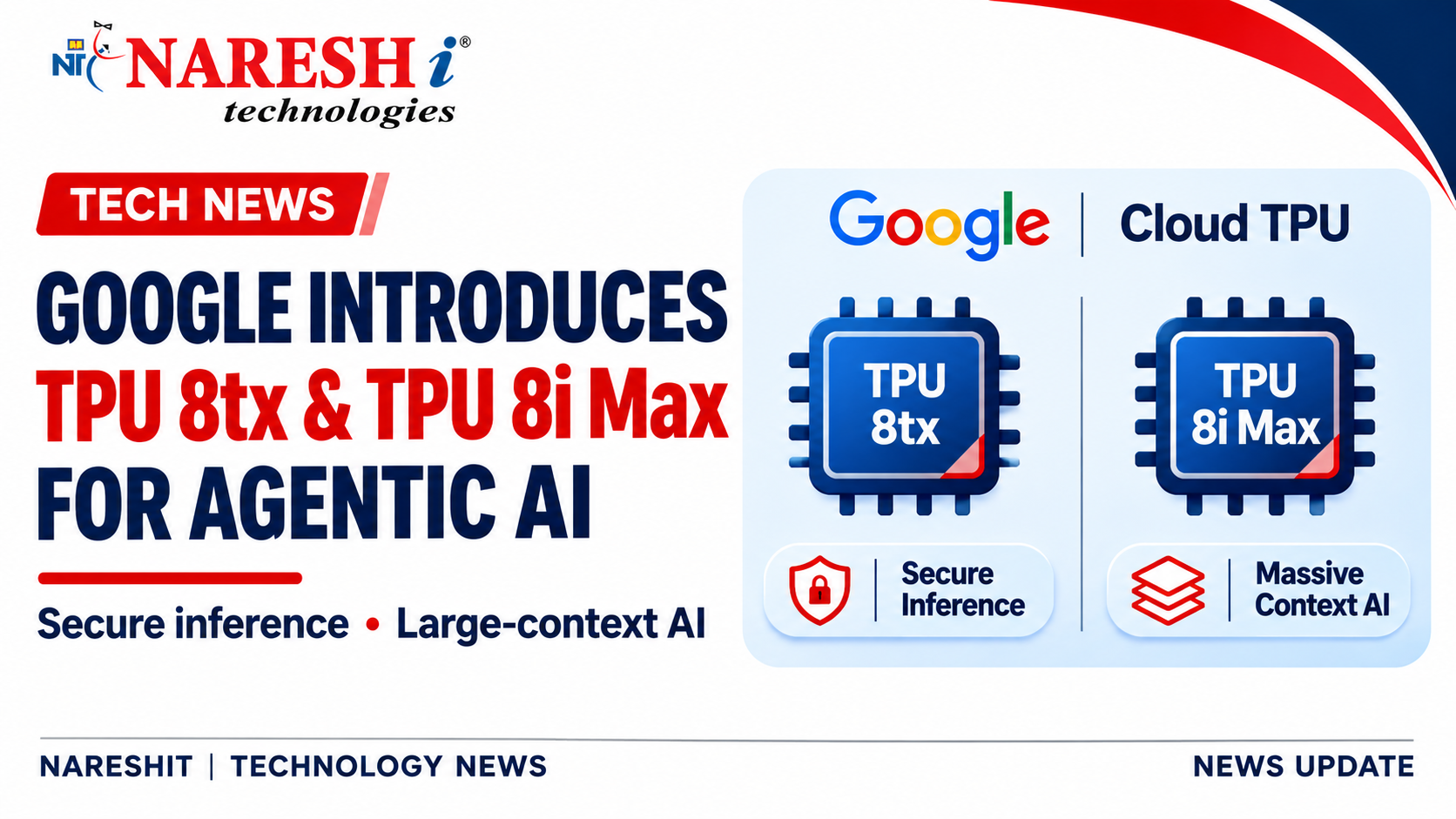
Google TPU 8tx and TPU 8i Max are two new AI infrastructure systems announced by Google on November 9, 2026. The announcement highlights growing demand for secure AI processing, large context windows and infrastructure designed for increasingly complex AI agents.
The development matters because modern Artificial Intelligence applications are moving beyond answering individual questions. Businesses are exploring AI systems that can analyse large datasets, work across software tools and perform connected tasks under human supervision.
Quick Answer: Google introduced TPU 8tx for secure, confidential AI inference and TPU 8i Max for large-context AI workloads and higher compute density. Both extend Google’s eighth-generation Tensor Processing Unit infrastructure for advanced AI applications.
What Has Google Announced?
Google expanded its eighth-generation TPU portfolio with two additional systems: TPU 8tx and TPU 8i Max.
The company previously introduced TPU 8t for large-scale model training and TPU 8i for real-time reasoning workloads.
The new systems address different infrastructure requirements.
- TPU 8tx: Focuses on confidential inference and sensitive enterprise AI workloads.
- TPU 8i Max: Focuses on large context windows, increased memory bandwidth and greater computing density.
Google describes these as specialized TPU systems rather than entirely new chip architectures. The distinction matters because system-level design also involves memory, networking, storage and security.
What Is Google TPU 8tx?
TPU 8tx is designed for organizations that need stronger protection while processing sensitive information using AI models.
Traditional data protection commonly involves encryption during storage and transmission. Confidential computing adds hardware-based protections for information while it is being processed.
According to Google, TPU 8tx combines existing eighth-generation TPU silicon with hardware-level confidential computing capabilities.
Google reports that the system can deliver up to twice the improvement in latency compared with TPU 8t for the workloads described in its announcement.
These are vendor-reported technical claims, not independent benchmarks for every application.
What Is Google TPU 8i Max?
TPU 8i Max addresses the computing demands created by AI applications that process large amounts of information at once.
Examples include analysing extensive software repositories, processing long documents and coordinating multiple AI agents.
Google states that TPU 8i Max combines two TPU 8i chips in one package, providing twice the compute, SRAM capacity and high-bandwidth memory bandwidth compared with TPU 8i.
This design targets workloads where memory capacity and bandwidth can become major performance constraints.
Google TPU 8tx vs TPU 8i Max: Key Differences
| Feature | TPU 8tx | TPU 8i Max |
|---|---|---|
| Primary focus | Confidential AI inference | Large-context AI processing |
| Main advantage | Hardware-based data protection | Greater compute and memory bandwidth |
| Typical application | Sensitive enterprise AI workflows | Large models and multi-agent workloads |
| Design objective | Security with low latency | Higher compute density |
Both systems serve different requirements within Google’s broader AI infrastructure strategy.
Why Does This Matter for Agentic AI?
Agentic AI refers to AI systems designed to work through connected tasks, use tools and perform actions within defined workflows.
Such applications may require substantial computing resources, especially when handling large context windows or coordinating multiple model interactions.
Google’s announcement reflects the growing need to consider memory management, security and infrastructure efficiency alongside model capability.
However, specialized hardware alone does not make an AI application reliable. Developers still need software engineering, evaluation, access controls and appropriate human oversight.
What Does Google’s Announcement Mean for Python Developers?
Google also described work to make TPU development more accessible through its software ecosystem.
The announcement highlights TorchTPU, an open-source integration intended to help developers run PyTorch workloads on TPUs without rewriting their models.
Google also described infrastructure tools supporting model serving, distributed processing and AI agent workloads.
For Python learners, the broader lesson is that modern AI development combines programming with machine learning frameworks and production infrastructure.
Understanding Python, PyTorch, model inference and performance evaluation provides useful foundations for exploring such systems.
How Is This Relevant to India’s AI and Cloud Computing Industry?
The announcement is global and does not establish a specific Indian availability date for these new systems.
Nevertheless, the technology highlights subjects relevant to developers and cloud professionals in India.
Students exploring AI careers can benefit from learning how machine learning models are developed, deployed, secured and monitored.
Cloud computing, container orchestration and automation also play important roles in operating production AI applications.
These are relevant technical learning areas, although the Google announcement does not itself establish new job openings or hiring numbers in India.
Which Skills Should Students Learn?
Beginners interested in AI infrastructure can follow a progressive learning path.
- Python Programming: Understand functions, data structures and application logic.
- Machine Learning: Learn model training, evaluation and preprocessing.
- Deep Learning: Explore neural networks and frameworks such as PyTorch.
- Generative AI: Understand foundation models, inference and context handling.
- Cloud Computing: Learn computing resources, networking, storage and security.
- DevOps: Explore Docker, Kubernetes, automation and monitoring.
Students can explore Full Stack Data Science with Generative AI Training in JNTU for AI-related foundations.
Those interested in infrastructure and application deployment can also explore DevOps with Multi Cloud Training in JNTU.
Frequently Asked Questions
1. What are Google TPU 8tx and TPU 8i Max?
They are specialized eighth-generation TPU systems announced by Google for confidential AI processing and large-context AI workloads.
2. When did Google announce these TPU systems?
Google announced TPU 8tx and TPU 8i Max on November 9, 2026.
3. What is the difference between TPU 8tx and TPU 8i Max?
TPU 8tx focuses on protecting sensitive data during AI inference, while TPU 8i Max targets larger workloads requiring increased compute capacity and memory bandwidth.
4. Are the new Google TPUs related to Agentic AI?
Yes. Google positions the systems for infrastructure requirements associated with advanced AI agents, including security and large-context processing.
5. What should beginners learn to understand AI infrastructure?
Python, Machine Learning, Deep Learning, Generative AI, cloud computing and deployment fundamentals are useful starting points.
Conclusion
The announcement of Google TPU 8tx and TPU 8i Max illustrates how AI infrastructure is becoming more specialized as organizations develop increasingly demanding AI applications.
Confidential computing and large-context processing are important considerations for enterprise AI systems.
For developers and students, the announcement reinforces the value of combining programming, AI fundamentals and cloud infrastructure knowledge.
Official News Source and References
Original announcement: November 9, 2026
Source: Google — Our Newest TPUs: 8tx and 8i Max, Built for the Agentic Era.
Read the Original Announcement on Google’s Official Blog
Google Cloud Technical Announcement
Editorial note: This article is an independently written educational news summary based on Google’s official announcement. Product capabilities and performance figures are attributed to Google.