
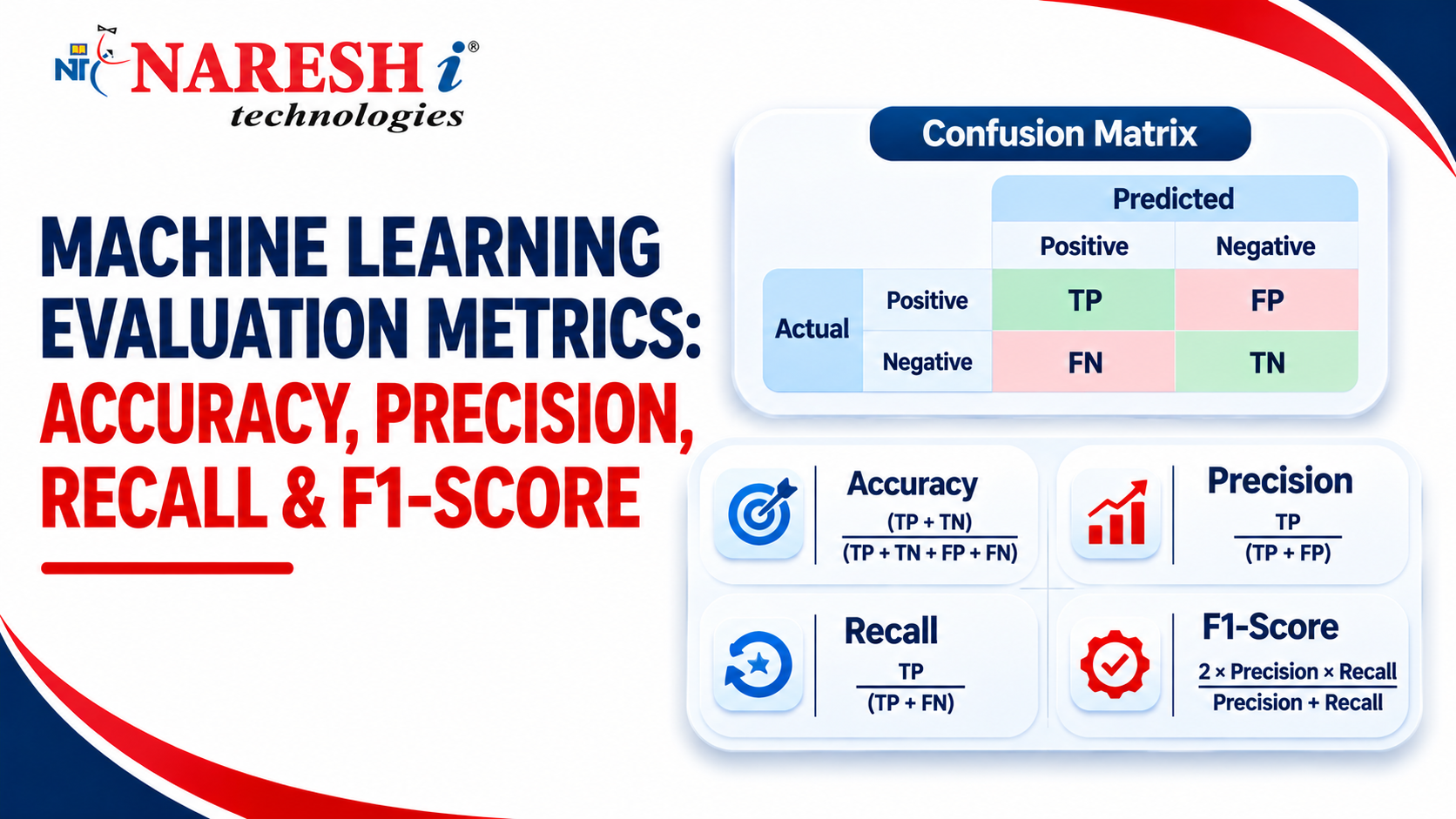
Machine Learning Evaluation Metrics help developers understand whether a classification model makes dependable predictions. A model can show high overall accuracy while failing to detect the cases that matter most. That is why accuracy, precision, recall and F1-score should be interpreted together rather than treated as interchangeable numbers.
Quick Answer: Accuracy measures all correct predictions; precision measures how many predicted positive cases are correct; recall measures how many actual positive cases are found; and F1-score balances precision and recall using their harmonic mean.
Why Are Machine Learning Evaluation Metrics Important?
Consider an email spam classifier. If most emails are legitimate, a system that labels everything as legitimate may achieve a deceptively high accuracy. Yet it fails at the task for which it was built. Metrics reveal these trade-offs and help teams compare models against practical requirements.
Understand the Confusion Matrix First
For binary classification, a confusion matrix contains four outcomes:
- True Positive (TP): A positive case correctly predicted as positive.
- True Negative (TN): A negative case correctly predicted as negative.
- False Positive (FP): A negative case incorrectly predicted as positive.
- False Negative (FN): A positive case incorrectly predicted as negative.
Imagine a model tested on 100 observations: TP = 30, TN = 60, FP = 5 and FN = 5. Each metric uses a different combination of these counts.
What Is Accuracy in Machine Learning?
Formula: Accuracy = (TP + TN) / (TP + TN + FP + FN).
For the example, accuracy is (30 + 60) / 100 = 90%. Accuracy is easy to understand but can hide poor detection of a rare class. Always inspect the class distribution before relying on it.
What Is Precision?
Formula: Precision = TP / (TP + FP).
Our classifier has precision of 30 / 35 = 85.7%. Of all records predicted positive, approximately 85.7% were genuinely positive. Precision matters when false alarms are costly, such as automatically flagging legitimate transactions as suspicious.
What Is Recall?
Formula: Recall = TP / (TP + FN).
Recall is also 30 / 35 = 85.7% here. It measures how many actual positive cases the model successfully identifies. Recall is important when missing a positive case carries a serious cost. The suitable trade-off depends on the application.
What Is F1-Score?
Formula: F1 = 2 × (Precision × Recall) / (Precision + Recall).
The F1-score is approximately 85.7% for this example. Because it is the harmonic mean, a very low precision or recall reduces the F1-score. However, F1 does not directly incorporate true negatives, so it is not sufficient for every problem.
Accuracy vs Precision vs Recall vs F1-Score
| Metric | Main Question | Useful When |
|---|---|---|
| Accuracy | How many predictions were correct? | Classes are reasonably balanced and errors have similar costs |
| Precision | How trustworthy are positive predictions? | False positives are costly |
| Recall | How many actual positives were detected? | False negatives are costly |
| F1-score | How well are precision and recall balanced? | Both types of positive-class error matter |
Python Example: Calculate Evaluation Metrics with Scikit-learn
Use the following example to reproduce the 100-observation confusion matrix and calculate all four scores.
from sklearn.metrics import (
    accuracy_score,
    precision_score,
    recall_score,
    f1_score,
    confusion_matrix
)

y_true = [1]*35 + [0]*65
y_pred = [1]*30 + [0]*5 + [1]*5 + [0]*60

print("Confusion matrix:")
print(confusion_matrix(y_true, y_pred))

print("Accuracy:", accuracy_score(y_true, y_pred))
print("Precision:", precision_score(y_true, y_pred))
print("Recall:", recall_score(y_true, y_pred))
print("F1:", f1_score(y_true, y_pred))
The confusion matrix uses actual classes as rows and predicted classes as columns. For more extensive reporting, Scikit-learn also provides classification_report(), showing per-class precision, recall, F1-score and support.
How Should You Evaluate Imbalanced Datasets?
Suppose only 2% of transactions are fraudulent. Predicting every transaction as legitimate produces 98% accuracy but zero recall for fraud.
Examine precision, recall, F1, class-specific support and, where appropriate, precision-recall curves or balanced accuracy.
For multiclass classification, pay attention to averaging methods. Macro averaging gives each class equal weight, whereas weighted averaging uses class support. Neither automatically reflects the real cost of mistakes.
How Can Beginners Improve Model Evaluation?
- Keep an untouched test dataset for final evaluation.
- Inspect the confusion matrix and per-class metrics.
- Choose metrics based on real errors and business objectives.
- Use stratified cross-validation when appropriate.
- Compare performance against a simple baseline.
- Check whether decision thresholds change precision and recall.
For deeper practice, students can explore full stack data science with generative ai training in jntu and build a customer churn or spam classification project.
Frequently Asked Questions
1. What is the best metric for a classification model?
There is no universal best metric. Choose based on class distribution, error costs and the task’s goals.
2. Is 95% accuracy always good?
No. It may be misleading when a model mostly predicts the majority class.
3. What is the difference between precision and recall?
Precision measures correct positive predictions among predicted positives; recall measures detected positives among all actual positives.
4. When should I use F1-score?
Use it when both precision and recall matter and their balance is useful for model comparison.
5. How can I calculate these metrics in Python?
Use accuracy_score, precision_score, recall_score and f1_score from Scikit-learn.
Conclusion
Understanding Machine Learning Evaluation Metrics helps developers move beyond a single headline accuracy number. Evaluate false positives, false negatives, class balance and real-world impact before choosing a model.
Start with a confusion matrix, calculate the key metrics and explain what each result means.
Discussion Question: For a fraud detection model, would you prioritize precision or recall—and why?