
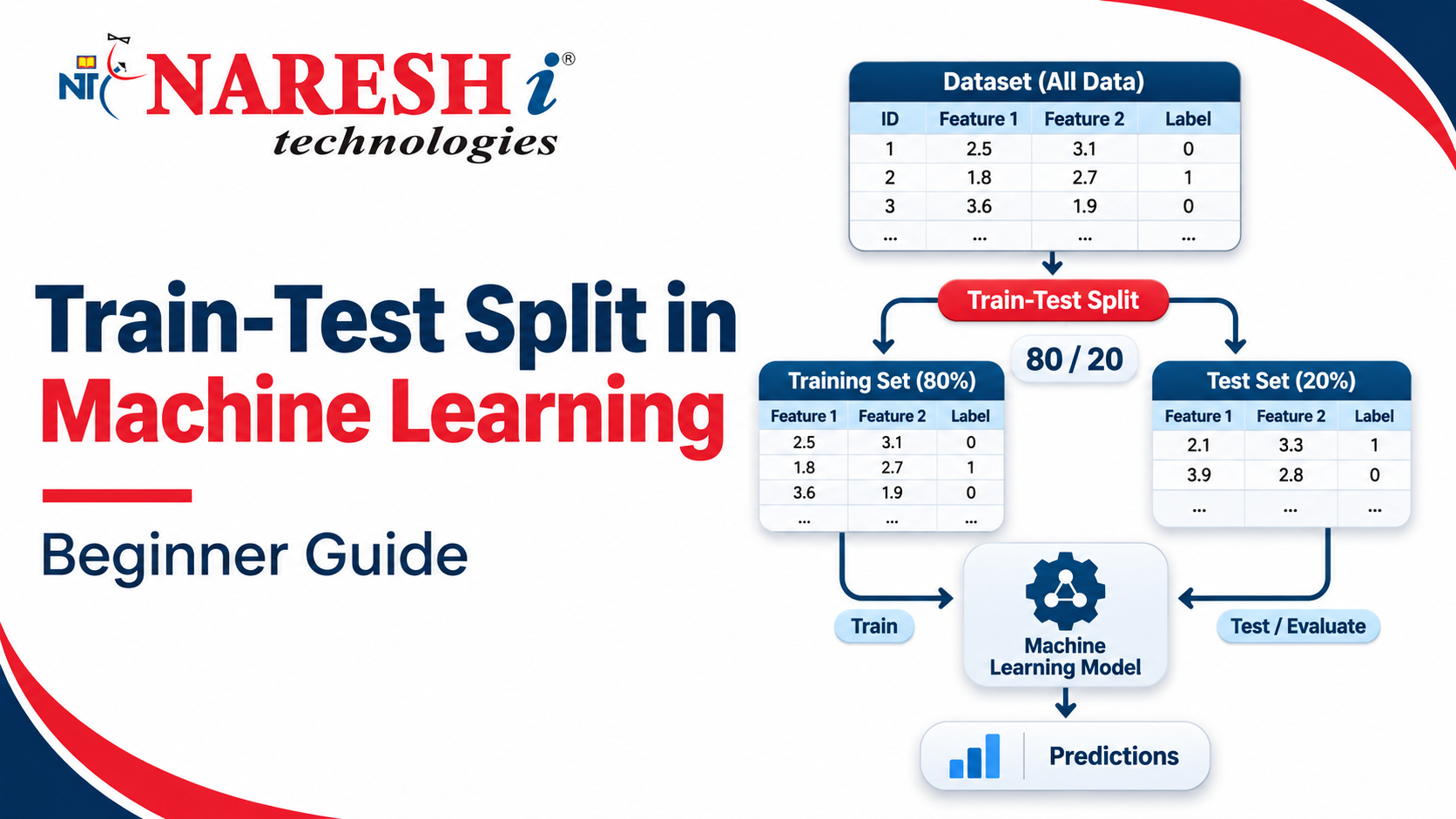
Train-Test Split in Machine Learning is one of the first concepts beginners should understand before building predictive models. It helps evaluate whether a model can perform well on data it has not encountered during training.
Imagine developing a model to predict house prices. If you train and evaluate it using exactly the same records, the results may look impressive even though the model performs poorly on new properties.
Quick Answer: A train-test split divides a dataset into separate training and testing subsets. The training data helps the model learn patterns, while the testing data evaluates its performance on unseen observations.
What Is a Train-Test Split in Machine Learning?
A train-test split is a model evaluation technique that separates available observations into two groups.
- Training Set: Data used to fit the machine learning model.
- Testing Set: Data reserved to evaluate the trained model.
For example, a dataset containing 1,000 customer records might be divided into 800 training records and 200 testing records.
This separation provides a more realistic estimate of how the model may perform on new customers, provided the split reflects the real-world prediction problem.
Why Is Train-Test Splitting Important?
Machine learning models learn relationships from examples. However, learning the training data too closely does not guarantee useful predictions.
Testing the model on unseen observations helps identify poor generalization and possible overfitting.
It also allows developers to compare model predictions with actual outcomes using suitable evaluation metrics.
A well-designed split supports more trustworthy model assessment, although it cannot correct biased data or an unsuitable evaluation strategy.
What Is the 80/20 Rule in Machine Learning?
An 80/20 split uses 80% of the dataset for training and 20% for testing.
For example, if a dataset contains 5,000 records, an 80/20 split assigns approximately 4,000 to training and 1,000 to testing.
However, 80/20 is a common starting point, not a universal requirement. A suitable split depends on dataset size, class distribution, time relationships and the model’s evaluation needs.
How to Perform Train-Test Split in Python
Scikit-learn provides the train_test_split() function, which divides features and target labels into aligned subsets.
Python Example Using the Iris Dataset
from sklearn.datasets import load_iris
from sklearn.model_selection import train_test_split

iris = load_iris()

X = iris.data
y = iris.target

X_train, X_test, y_train, y_test = train_test_split(
    X,
    y,
    test_size=0.2,
    random_state=42,
    stratify=y
)

print("Training:", X_train.shape)
print("Testing:", X_test.shape)
The example produces 120 training observations and 30 testing observations.
The test_size=0.2 parameter reserves 20% of the dataset for testing, while random_state=42 makes the random split reproducible.
The stratify=y option helps preserve the class proportions in both subsets, which is useful for classification.
Training Data vs Testing Data: Key Differences
| Feature | Training Data | Testing Data |
|---|---|---|
| Purpose | Learn patterns | Evaluate predictions |
| Model fitting | Used during training | Not used for fitting |
| Preprocessing | Fit and transform | Apply learned transformation |
| Evaluation | Training performance | Unseen-data performance |
| Typical allocation | 80% | 20% |
These percentages are illustrative. Other allocations and validation approaches may be more appropriate for particular datasets.
What Is Data Leakage in Machine Learning?
Data leakage occurs when information unavailable at prediction time improperly influences model development.
One common example involves scaling a complete dataset before dividing it into training and testing subsets.
When scaling parameters are calculated using the entire dataset, information from the test set influences preprocessing.
This can make evaluation results overly optimistic.
How Can Beginners Avoid Data Leakage?
The safest general approach is to split the data before fitting preprocessing operations.
Use the training subset to learn scaling parameters, missing-value replacements or other preprocessing statistics.
Then apply those learned transformations to the test subset without fitting them again.
Scikit-learn Pipelines help organize this process.
Python Example: Safe Preprocessing with Pipeline
from sklearn.pipeline import make_pipeline
from sklearn.preprocessing import StandardScaler
from sklearn.linear_model import LogisticRegression
from sklearn.metrics import accuracy_score

model = make_pipeline(
    StandardScaler(),
    LogisticRegression(max_iter=1000)
)

model.fit(X_train, y_train)

predictions = model.predict(X_test)

accuracy = accuracy_score(y_test, predictions)

print("Test Accuracy:", round(accuracy, 3))
The pipeline fits the scaler using training data and applies the learned transformation when predicting test observations.
This reduces a common leakage risk and makes the workflow easier to reproduce.
When Should You Use Stratified or Time-Based Splitting?
Random splitting is suitable for many independent observations, but it is not appropriate for every problem.
For imbalanced classification datasets, stratification can help preserve class proportions across training and testing subsets.
For time-series predictions, chronological splitting is often more realistic because the model should learn from earlier observations and predict later ones.
For datasets containing repeated measurements from the same individual or organisation, group-aware splitting can help prevent related observations appearing in both subsets.
What Is the Difference Between Validation and Testing Data?
Training data fits the model. Validation data helps select settings, compare approaches and tune hyperparameters.
Testing data is ideally held aside for a final evaluation after development decisions are complete.
For smaller datasets, cross-validation can make more effective use of available training observations.
Repeatedly changing the model based on test-set results can undermine the independence of the final evaluation.
Common Train-Test Split Mistakes
Beginners should avoid fitting preprocessing operations before splitting, repeatedly tuning models on test results and ignoring class imbalance.
Another mistake is randomly shuffling chronological data when the real application predicts future outcomes.
Use an evaluation approach that resembles the conditions under which the model will operate.
Beginner Project: Student Performance Prediction
A student performance dataset is a useful way to practise data splitting.
- Collect suitable academic performance records.
- Identify relevant input features and the target variable.
- Split the dataset into training and testing subsets.
- Build a preprocessing and modelling pipeline.
- Train the model using training observations.
- Evaluate predictions on the held-out test set.
- Document accuracy, limitations and potential sources of leakage.
This exercise helps connect Python programming, preprocessing and responsible model evaluation.
Frequently Asked Questions
1. What is Train-Test Split in Machine Learning?
It is a technique that separates data into training and testing subsets so model performance can be evaluated on unseen observations.
2. Is an 80/20 split always the best choice?
No. The appropriate split depends on dataset size, distribution and evaluation requirements. An 80/20 division is only a common starting point.
3. What does random_state=42 mean in Python?
It sets a reproducible random seed for the splitting operation, allowing the same input data and settings to produce the same random split.
4. What is data leakage in Machine Learning?
Data leakage happens when information that should not be available during model development improperly influences the training or evaluation process.
5. Should feature scaling happen before Train-Test Split?
No. First separate the dataset, then fit scaling operations using training data. Apply the learned transformation to testing data.
Conclusion
Train-Test Split in Machine Learning is a foundational step toward building models that can generalize beyond their training examples.
Learning how to split datasets, avoid leakage and evaluate predictions correctly helps beginners develop more reliable machine learning workflows.
Students interested in strengthening Python, statistics and practical machine learning skills can explore Full Stack Data Science with Generative AI Training.
Discussion Question: Which method would you use for evaluating a sales forecasting model: random train-test splitting or chronological splitting?