
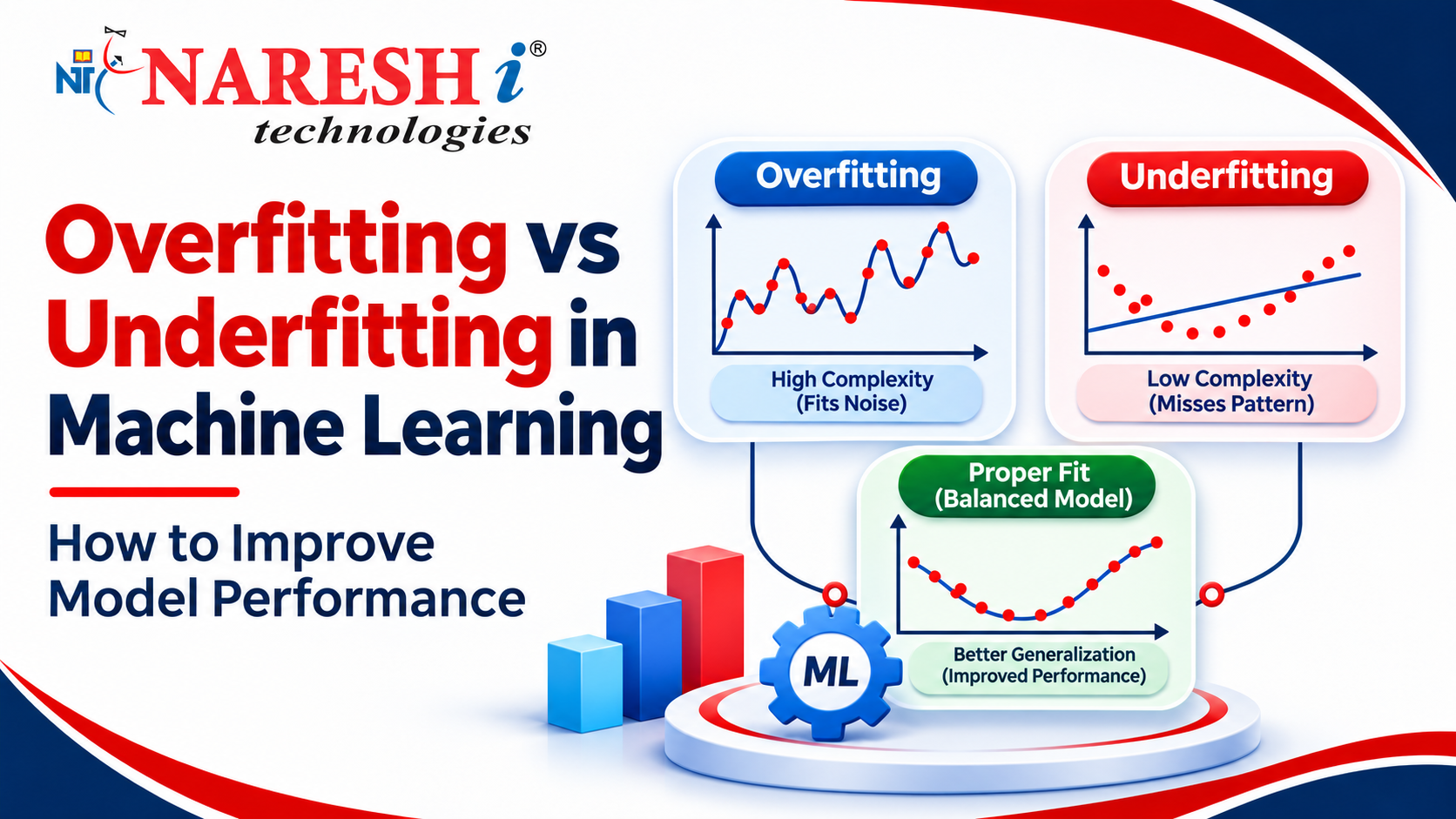
Overfitting vs Underfitting in Machine Learning is an important concept for students learning how to build accurate and reliable predictive models. A model may perform exceptionally well on training data but struggle with new observations. Another model may fail to learn even the basic relationships in its training dataset.
These situations are known as overfitting and underfitting. Understanding their causes helps beginners improve model selection, training and evaluation.
Quick Answer: Overfitting occurs when a model learns training-specific details, including noise, and fails to generalize effectively. Underfitting occurs when a model is too limited or insufficiently trained to capture meaningful patterns in the data.
What Is Overfitting in Machine Learning?
Overfitting happens when a machine learning model follows its training observations too closely and performs substantially worse on unseen data.
For example, imagine a house price prediction model trained on a small dataset. A highly complex model may learn unusual details about individual properties instead of the broader relationships affecting property values.
It may produce very low training errors but much larger testing errors.
Common signs of overfitting:
- Excellent performance on training data.
- Significantly weaker performance on validation data.
- Large differences between training and validation errors.
- Unstable predictions when evaluated on new observations.
Overfitting is particularly concerning because impressive training accuracy does not guarantee reliable real-world predictions.
What Is Underfitting in Machine Learning?
Underfitting occurs when a model cannot adequately represent the underlying relationship in the dataset.
Imagine trying to predict a curved relationship using a straight-line model that is too simple for the available information.
The model may fail to capture important trends and produce large errors on both training and testing data.
Common signs of underfitting:
- Poor performance on training data.
- Poor performance on validation data.
- Failure to capture important relationships.
- Predictions that are overly simplistic.
Underfitting can occur when the model is insufficiently flexible, important features are missing, or training is inadequate.
Overfitting vs Underfitting: Key Differences
| Factor | Overfitting | Underfitting |
|---|---|---|
| Model behaviour | Learns training details too closely | Fails to learn important patterns |
| Training error | Often low | Often high |
| Validation error | Higher than training error | Often high |
| Typical problem | Excessive model flexibility | Insufficient model flexibility |
| Possible solution | Regularization or simpler models | More suitable features or models |
Both problems reduce model usefulness. The objective is to find a balance that captures meaningful patterns without learning unnecessary noise.
What Is the Bias-Variance Tradeoff?
The bias-variance tradeoff explains how model complexity can influence prediction errors.
Bias refers to errors associated with overly restrictive assumptions. High-bias models may struggle to represent complex relationships.
Variance refers to how much predictions may change when the training dataset changes. High-variance models may be sensitive to small variations in the observations.
Underfitting is commonly associated with high bias, while overfitting is often associated with high variance.
Successful machine learning requires choosing a model that generalizes effectively rather than simply minimizing training error.
How to Identify Overfitting Using Python
Scikit-learn provides tools for training models and comparing their performance on training and testing datasets.
The following example uses a decision tree classifier with the Iris dataset.
from sklearn.datasets import load_iris
from sklearn.model_selection import train_test_split
from sklearn.tree import DecisionTreeClassifier

X, y = load_iris(return_X_y=True)

X_train, X_test, y_train, y_test = train_test_split(
    X,
    y,
    test_size=0.2,
    random_state=42,
    stratify=y
)

model = DecisionTreeClassifier(
    random_state=42
)

model.fit(X_train, y_train)

train_score = model.score(X_train, y_train)
test_score = model.score(X_test, y_test)

print("Training Accuracy:", train_score)
print("Testing Accuracy:", test_score)
Compare training and testing accuracy. A large performance gap, particularly when training accuracy is high, can suggest overfitting.
However, one train-test comparison does not prove that a model is overfitting. Cross-validation and repeated evaluation provide additional evidence.
How Can You Prevent Overfitting?
Several techniques can help reduce overfitting, depending on the model and available dataset.
1. Use Cross-Validation
Cross-validation evaluates a model using multiple training and validation splits. It helps reveal whether performance depends heavily on one particular split.
2. Apply Regularization
Regularization discourages overly complex models. Examples include L1 and L2 penalties in suitable linear models.
3. Control Model Complexity
Limit decision tree depth, adjust the minimum number of samples per leaf, or simplify other model settings.
4. Improve Data Quality
Investigate incorrect labels, duplicate records and irrelevant features. More representative training data can improve generalization.
How Can You Fix Underfitting?
Underfitting requires a different approach. A model may need additional flexibility, better features or an improved training process.
Consider a more expressive algorithm, reduce excessive regularization where appropriate, and investigate whether important predictors are missing.
For iterative models, verify that training has converged rather than stopping too early.
Every change should be evaluated against validation data instead of relying only on training accuracy.
Beginner Project: Compare Decision Tree Models
Build a simple experiment to understand how model complexity influences performance.
- Load a classification dataset.
- Divide observations into training and testing subsets.
- Train a shallow decision tree.
- Train another tree with greater allowed depth.
- Compare training and validation performance.
- Use cross-validation to select suitable complexity.
- Evaluate the chosen model on held-out test data.
Document the results using a table or graph. This project can demonstrate model evaluation, hyperparameter selection and generalization concepts.
Frequently Asked Questions
1. What is the difference between overfitting and underfitting?
Overfitting occurs when a model learns training-specific details too closely, while underfitting occurs when it cannot capture important patterns.
2. How do you identify overfitting in machine learning?
Compare training and validation performance. Strong training results combined with substantially weaker validation performance can indicate overfitting.
3. Can cross-validation help prevent overfitting?
Cross-validation supports more reliable model selection and evaluation, although it does not automatically eliminate overfitting.
4. What causes underfitting?
Common causes include an overly simple model, missing important features, excessive regularization or insufficient training.
5. Is overfitting always caused by too much training?
No. Model complexity, limited data, noisy observations and unsuitable feature selection can also contribute to overfitting.
Conclusion
Understanding Overfitting vs Underfitting in Machine Learning is essential for developing predictive models that perform reliably on unseen data.
Overfitting often produces strong training results but poor generalization. Underfitting prevents the model from learning meaningful relationships.
Use suitable model complexity, cross-validation, careful preprocessing and appropriate evaluation metrics to improve your results.
Students interested in Python, machine learning and modern AI applications can explore Full Stack Data Science with Generative AI Training.
Discussion Question: If a model achieves 99% training accuracy but only 70% testing accuracy, what would you investigate first?