
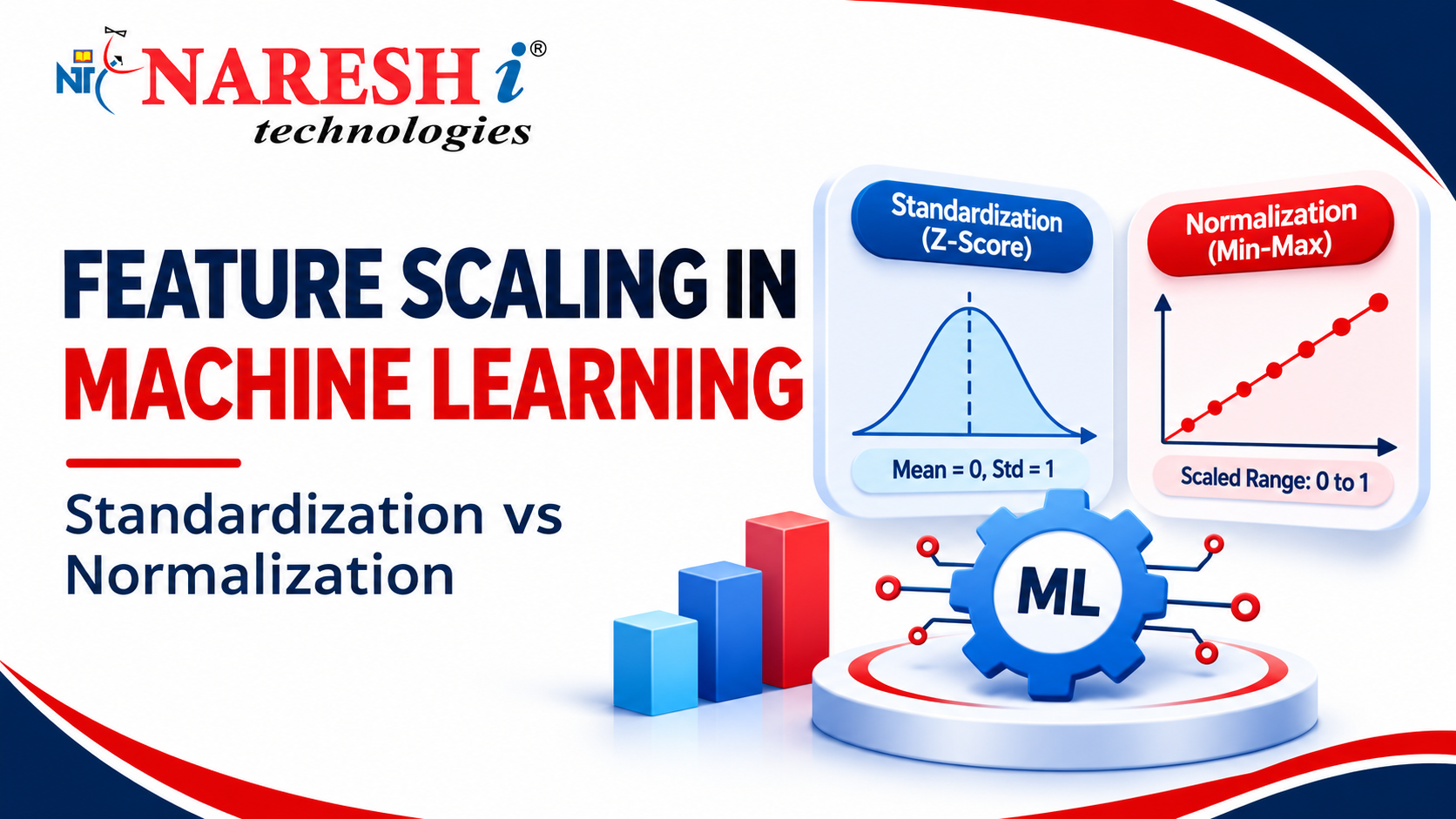
Feature Scaling in Machine Learning is an important preprocessing technique that helps algorithms work with numerical variables measured on different scales.
Imagine building a model using customer age and annual income. Age might range from 18 to 65, while income could range from ₹20,000 to ₹15,00,000. Without appropriate scaling, the larger numerical values may disproportionately influence some algorithms.
Quick Answer: Feature scaling transforms numerical variables into more comparable scales. Standardization commonly produces features with mean zero and standard deviation one, while Min-Max normalization rescales training values to a selected range, usually zero to one.
What Is Feature Scaling in Machine Learning?
Feature scaling is the process of transforming numerical input features so differences in measurement units or magnitude do not unnecessarily affect model training.
For example, a customer dataset might contain age, monthly spending and transaction frequency. These features represent different quantities, and their numerical ranges can vary significantly.
Scaling helps certain algorithms compare their values more appropriately. However, not every machine learning model requires scaled inputs.
Why Is Feature Scaling Important?
Several machine learning techniques rely on distances, numerical optimisation or regularisation.
Without suitable scaling, a feature with large numerical values may have a stronger influence than intended.
Feature scaling can be useful for:
- K-Nearest Neighbors, which compares distances between observations.
- Support Vector Machines, particularly with distance-based kernels.
- K-Means clustering, which groups observations using distances.
- Logistic Regression and other regularised linear models.
- Neural networks, where input scales may affect training behaviour.
Decision trees and tree-based ensembles are generally less sensitive to monotonic changes in feature scale.
What Is Standardization in Machine Learning?
Standardization transforms a numerical feature by subtracting its mean and dividing the result by its standard deviation.
The standard score formula is:
z = (x – mean) / standard deviation
For the training dataset, this generally produces a transformed feature with mean zero and standard deviation one.
Standardization does not automatically make a distribution normal, and it does not remove the effects of outliers.
Python Example: StandardScaler
import pandas as pd
from sklearn.preprocessing import StandardScaler

data = pd.DataFrame({
    "Age": [20, 25, 30, 35, 40],
    "Income": [25000, 35000, 45000, 60000, 75000]
})

scaler = StandardScaler()

scaled_data = scaler.fit_transform(data)

print(scaled_data)
Scikit-learn calculates the mean and standard deviation of each training feature and applies the corresponding transformation.
What Is Normalization in Machine Learning?
In many beginner discussions, normalization refers to Min-Max scaling, which transforms each feature into a chosen numerical range.
For the usual range of zero to one, the formula is:
x_scaled = (x – minimum) / (maximum – minimum)
This preserves the order of values while changing their scale.
However, Min-Max scaling does not eliminate outliers. An extreme value can compress most other observations into a narrow portion of the range.
Python Example: MinMaxScaler
from sklearn.preprocessing import MinMaxScaler

scaler = MinMaxScaler()

normalized_data = scaler.fit_transform(data)

print(normalized_data)
The minimum and maximum values observed during fitting determine the transformation. New data outside the training range may produce values below zero or above one.
Standardization vs Normalization: Key Differences
| Feature | Standardization | Min-Max Normalization |
|---|---|---|
| Method | Mean and standard deviation | Minimum and maximum |
| Typical result | Mean 0, standard deviation 1 | Training values between 0 and 1 |
| Fixed output range | No | Yes, for fitted training values |
| Outlier sensitivity | Sensitive | Sensitive |
| Python class | StandardScaler | MinMaxScaler |
How to Scale Training and Testing Data Correctly
One of the biggest preprocessing mistakes is scaling an entire dataset before dividing it into training and testing sets.
This allows information from the test dataset to influence the scaling parameters, potentially creating data leakage and misleading model evaluation results.
A safer approach is to split the data first and fit the scaler only on the training set.
from sklearn.model_selection import train_test_split
from sklearn.preprocessing import StandardScaler

X = data[["Age", "Income"]]

X_train, X_test = train_test_split(
    X,
    test_size=0.2,
    random_state=42
)

scaler = StandardScaler()

X_train_scaled = scaler.fit_transform(X_train)
X_test_scaled = scaler.transform(X_test)
In complete machine learning applications, Scikit-learn Pipelines help organise these preprocessing operations and reduce leakage risks during model evaluation.
Which Feature Scaling Method Should Beginners Choose?
There is no universally best scaling method.
Standardization is a useful starting choice for many linear, distance-based and optimisation-based algorithms. Min-Max scaling may be suitable when a bounded feature range is desirable.
If a dataset contains significant outliers, consider investigating RobustScaler or other appropriate transformations instead of assuming either method will solve the problem.
The final choice should be evaluated using the model, dataset and actual performance results.
Real-World Project: Customer Segmentation
Imagine a retail company wants to group customers based on age, annual income and spending frequency.
Students can build a simple customer segmentation project by following these steps:
- Collect or download a suitable customer dataset.
- Inspect missing values and unusual observations.
- Select relevant numerical features.
- Split data appropriately for the intended evaluation.
- Apply a suitable feature scaling method.
- Experiment with K-Means clustering.
- Visualise customer groups and interpret the findings.
Compare results using different scaling approaches. This helps demonstrate how preprocessing choices can affect distance-based clustering.
Common Feature Scaling Mistakes to Avoid
Beginners sometimes scale every column without checking whether it represents a meaningful numerical measurement.
Identifiers, category codes and target labels should not automatically be treated as continuous numerical features.
Other common mistakes include fitting scalers on test data, assuming Min-Max scaling removes outliers and forgetting to apply the same transformation to future inputs.
Document preprocessing decisions so another developer can reproduce the experiment.
Frequently Asked Questions
1. What is Feature Scaling in Machine Learning?
Feature scaling transforms numerical input features into more comparable scales, helping certain algorithms train and evaluate data more appropriately.
2. What is the difference between Standardization and Normalization?
Standardization commonly uses the mean and standard deviation, while Min-Max normalization rescales training values into a specified range.
3. Is Feature Scaling necessary for every Machine Learning model?
No. Distance-based and regularised models often benefit from scaling, while many tree-based models are less sensitive to it.
4. What is StandardScaler in Python?
StandardScaler is a Scikit-learn transformer that standardizes numerical features using statistics learned from training data.
5. Should Feature Scaling happen before train-test splitting?
No. Split the data first, fit the scaler on training data and apply the learned transformation to test data to reduce leakage risks.
Conclusion
Feature Scaling in Machine Learning helps beginners understand how preprocessing decisions influence model behaviour.
Standardization and Min-Max normalization offer different ways to transform numerical features. Rather than memorising one method as the best, practise both and evaluate their suitability for each problem.
Students interested in further learning can explore Full Stack Data Science with Generative AI Training.
Discussion Question: Which preprocessing technique would you test first for a K-Means customer segmentation project: StandardScaler or MinMaxScaler?